Health News > Skin Health
Here's Why Creams Can't Make Your Dark Spots Disappear (Hint: It’s Not Your Skin’s Fault)
The patches aren't located where you think they are, and that changes everything about how to treat them...

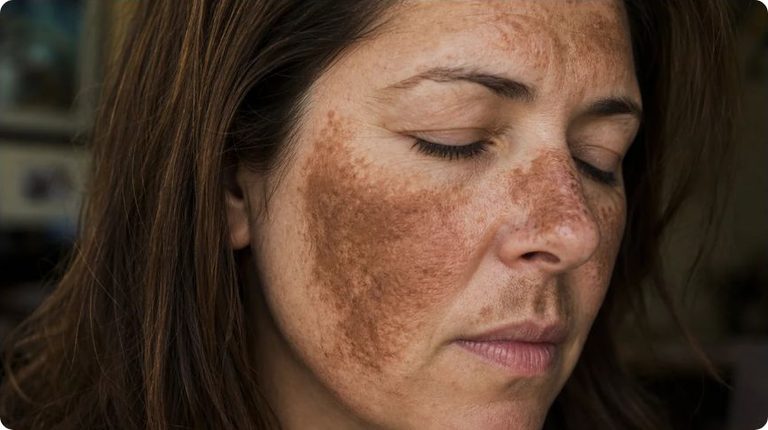
I’m about to say something that might get me into trouble with half the dermatologists I trained with.
For twelve years, I handed out the same prescription pad.
Hydroquinone at 4%, twice a day, follow-up in eight weeks.
And for twelve years, I watched the same patients walk back through my door—not better, sometimes worse.
One Tuesday afternoon in March, at 4:40 PM, in consultation room two, I had three in a row.
Same chair. Same mirror. Same question.
“Why did it come back darker than before?”
I didn’t have a real answer for the third one that day.
I just adjusted the strength and sent her home.
Have you been told your dark spots were "just hormonal" and left to figure it out alone?
Have you ever had someone’s eyes drift to your cheek mid-conversation, and you just kept smiling?
Have you ever stood in a bathroom lit brighter than your bedroom, wondering whether today was going to be a good skin day or a bad one?
Have you ever found yourself in a photo you didn’t pose for and didn’t recognize your own cheeks?
If you see yourself in this description, please keep reading.
Because what I’m about to explain isn’t in the patient handout we hand you at the front desk.
"I've Already Tried Everything"
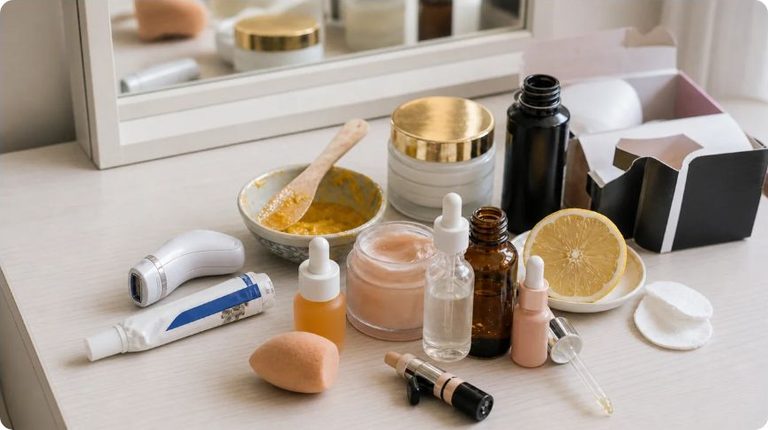
I know. I’ve heard it in that exact tone four hundred times.
Hydroquinone creams: They fade the surface color temporarily. Then, in some patients, an entirely different problem develops: a slate-gray discoloration called ochronosis, which is far harder to treat than the melasma ever was.
Kojic acid and brightening creams: The ones with the prettiest packaging. Same depth problem. A shade lighter for a few weeks, then straight back to baseline.
Chemical peels: TCA peels strip the surface layers. For a few weeks, the skin looks clean. Then the inflammation from the peel itself triggers the exact same cells to regenerate pigment.
Lasers and IPL: This is the one that breaks my heart most, because I referred patients for it myself. Heat stresses the skin, and heat injury is a trigger; some patients come back worse than when they started.
Vitamin C serums: Gentle, pleasant. For melasma in particular, it’s almost cosmetic—like putting a light coat of paint over a wall that has its own underlying issue.
Lemon juice, turmeric paste, and home remedies: I don’t blame anyone for trying. But when patients turn to kitchen ingredients, they’ve usually already lost all faith in prescription medicine.
Every single one of these does the same job: wiping paint off a wall.
None of them are designed to reach what's actually behind it.
The Paper I Wasn't Supposed to Read Closely
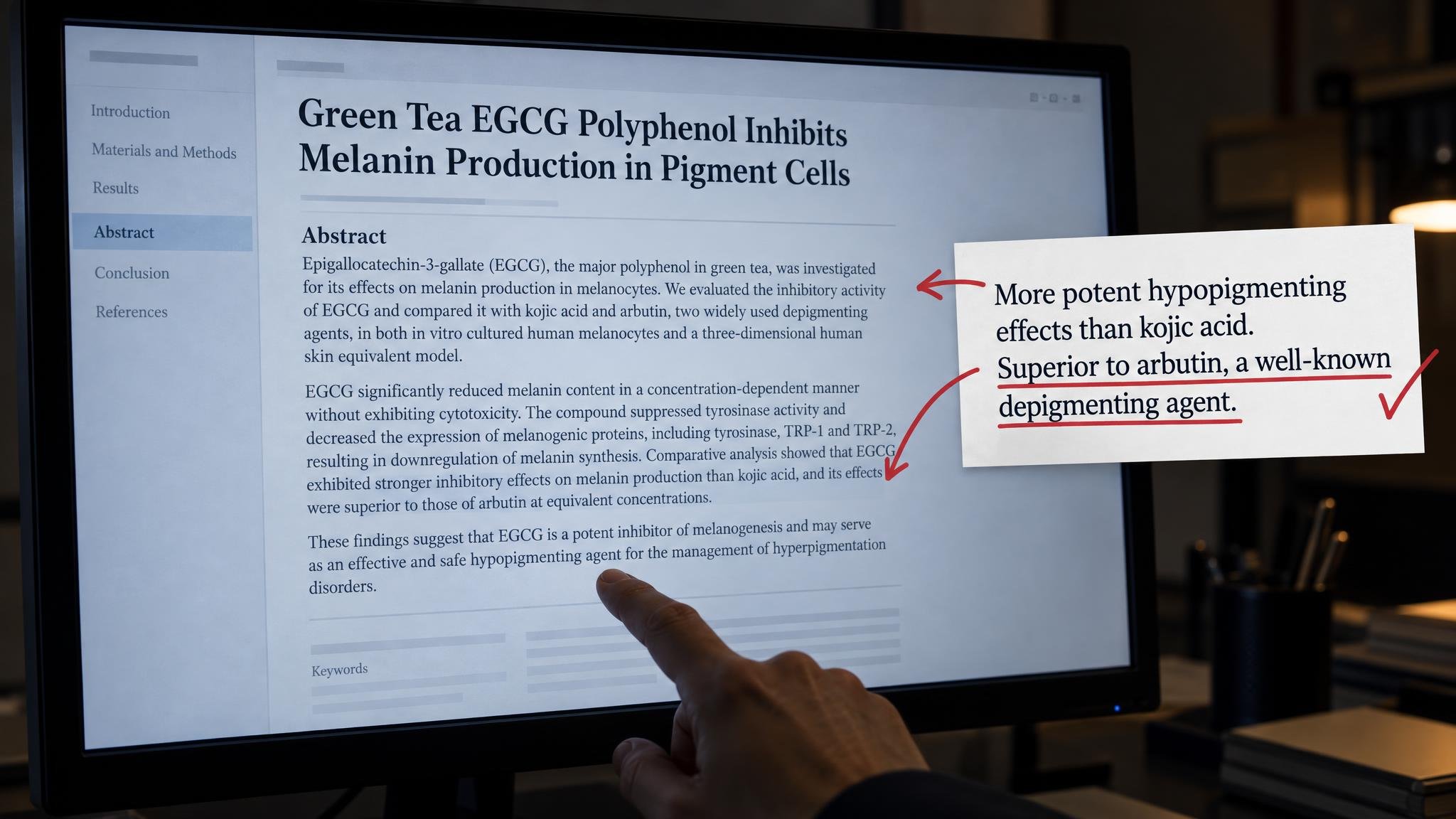
Two years ago, a dermatology research colleague sent me a stack of in vitro studies—the kind of papers most clinicians skim and file away.
One sentence stopped me.
Green tea EGCG was tested head-to-head against arbutin, a brightening agent in half the products I was recommending. EGCG won. Not a tie: the researchers judged it superior.
"More potent hypopigmenting effects than kojic acid."
"Superior to arbutin, a well-known depigmenting agent."
I read that sentence three times.
I was telling patients their options were limited to "what we have available."
Nobody had mentioned that higher-quality science had already been published in a journal nobody in my field reads outside of academic circles.
Why It Actually Works, in Plain Terms
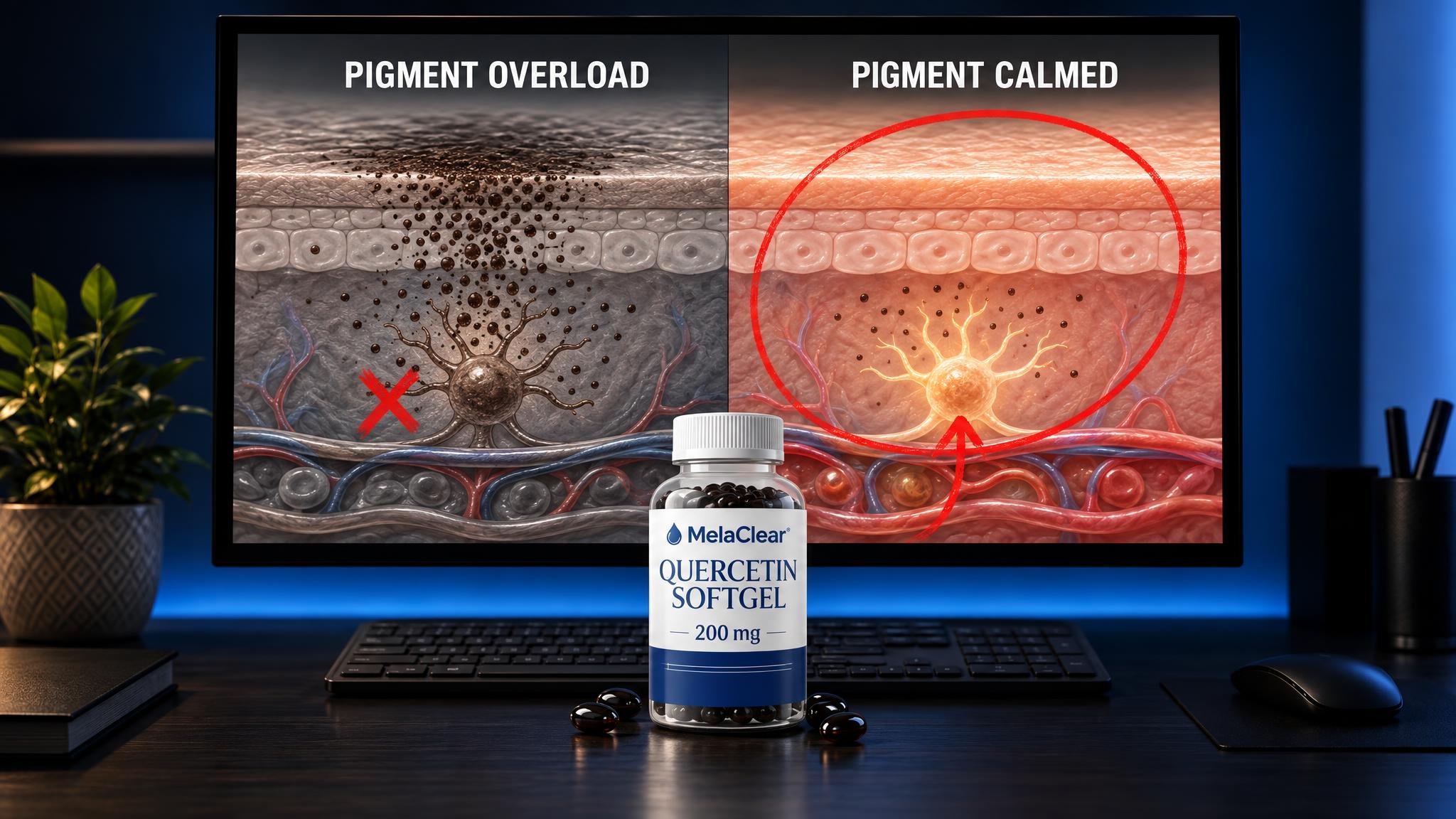
Your skin color comes from cells called melanocytes, located an entire layer below the surface you can see and touch.
Think of them as a paint sprayer hidden inside a wall, always plugged in and always running.
- Hydroquinone cleans the wall.
- A peel sands it.
- A laser burns the top layer.
Nothing reaches the sprayer. So the sprayer keeps running, and the wall gets painted all over again.
The trigger that keeps the sprayer running is an enzyme called tyrosinase, over-activated by sun, hormones, heat, or inflammation.
Every topical treatment on the market is designed to work on the paint, not the sprayer, because a cream simply cannot penetrate deep enough to reach it.
It’s not a strength problem. It’s a physics problem.
QUICK CLINICAL TAKEAWAY
Creams stop at the surface. Melanocytes live beneath. The only way to reach the sprayer is through the bloodstream.
👉 See How the Systemic Route Reaches the Melanocyte Layer →Why Your Dermatologist Probably Hasn't Told You This

I don’t think it’s a conspiracy, and I won’t pretend it is. It’s a business model.
Aesthetic dermatology is built on repeat consultations, recurring chemical peels, and renewed prescriptions.
The industry figures show it clearly: high-margin, out-of-pocket procedures that create recurring revenue over time.
The melasma treatment market alone was valued at $2.85 billion in 2022. It is projected to reach $4.83 billion by 2030. The market keeps growing because none of the existing treatments actually put an end to the problem.
A daily treatment that addresses the real root cause, taken at home with breakfast, puts an end to that cycle of repeated appointments.
Nobody builds a clinic around a softgel you take at your kitchen table.
It’s not necessarily malice. It’s just that there’s no financial incentive to look in that direction.
What I Started Recommending Instead
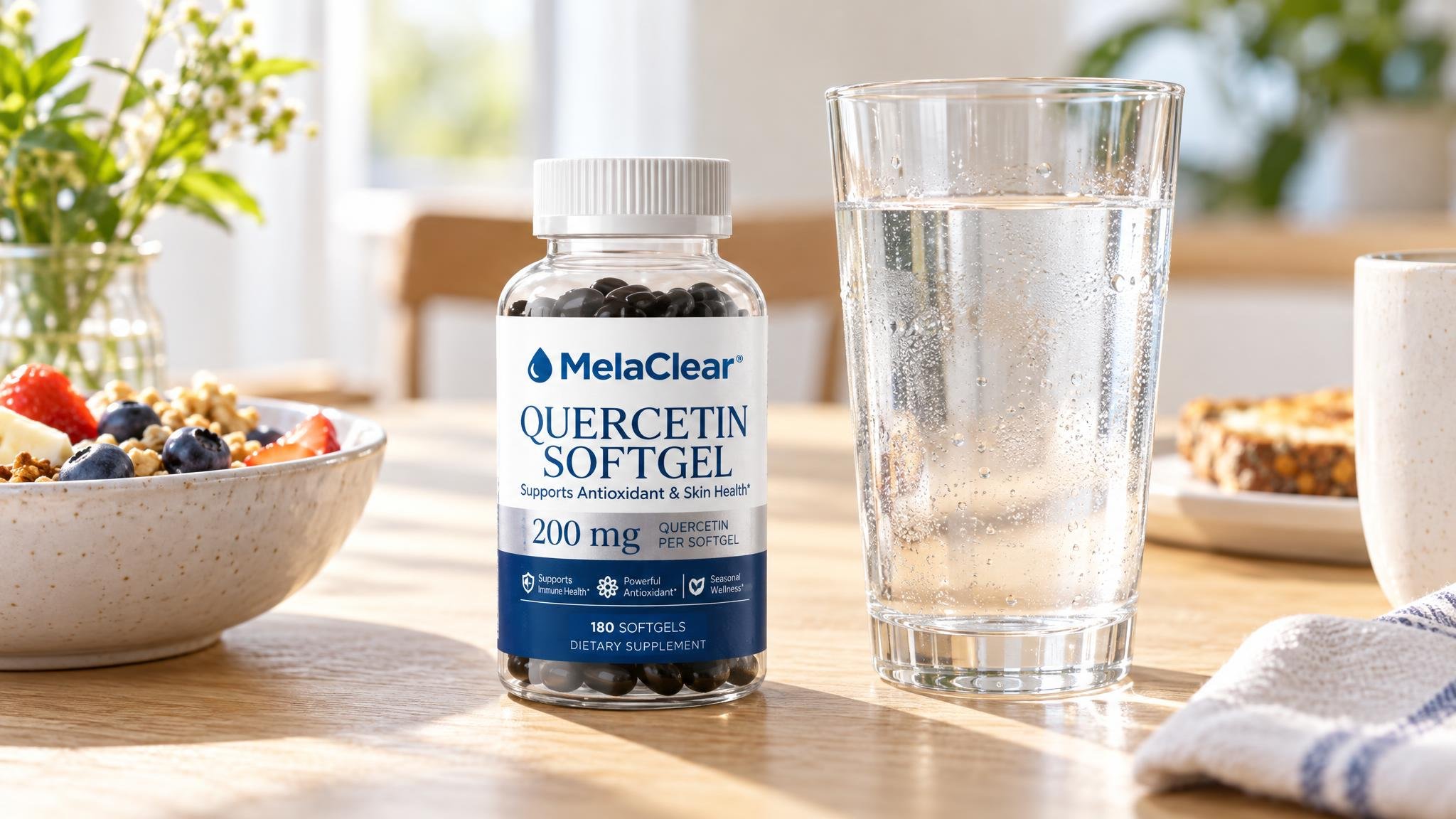
The route that actually reaches the melanocyte layer is systemic, through the bloodstream, not through the surface of the skin.
Oral tranexamic acid was already proving the concept: a published study of 561 patients showed improvement in nearly 9 out of 10 cases, because it worked from the inside out instead of fighting the surface.
However, oral tranexamic acid is a prescription medication, and in rare cases carries real clotting risks that I won't minimize. I wanted an alternative that took that exact same systemic route, without the prescription risks.
That search led me to a softgel called MelaClear™.
Quercetin and green tea extract (EGCG), absorbed through the digestive tract, carried by the blood vessels that nourish the skin, reaching the melanocyte from underneath—the exact same layer prescription drugs reach, but using food-derived botanical compounds instead of pharmaceuticals.
- Quercetin & Green Tea EGCG: The primary active compound that directly quiets the tyrosinase enzyme at the cell level.
- Zinc: To soothe the micro-inflammation that triggers melanocytes.
- Bromelain: To help clear and shed old, oxidized surface pigment.
- Ashwagandha: To reduce cortisol, the stress hormone responsible for keeping overworked pigment cells switched on.
One targeted botanical combination to turn off the sprayer, supported by three nutrients to keep it from switching back on.
BATCH VERIFICATION
Non-prescription. No hydroquinone. No tranexamic acid. No forced cycling or rebound risk.
👉 Check MelaClear Clinical Availability & Protocol Options →The Gap Nobody Points Out
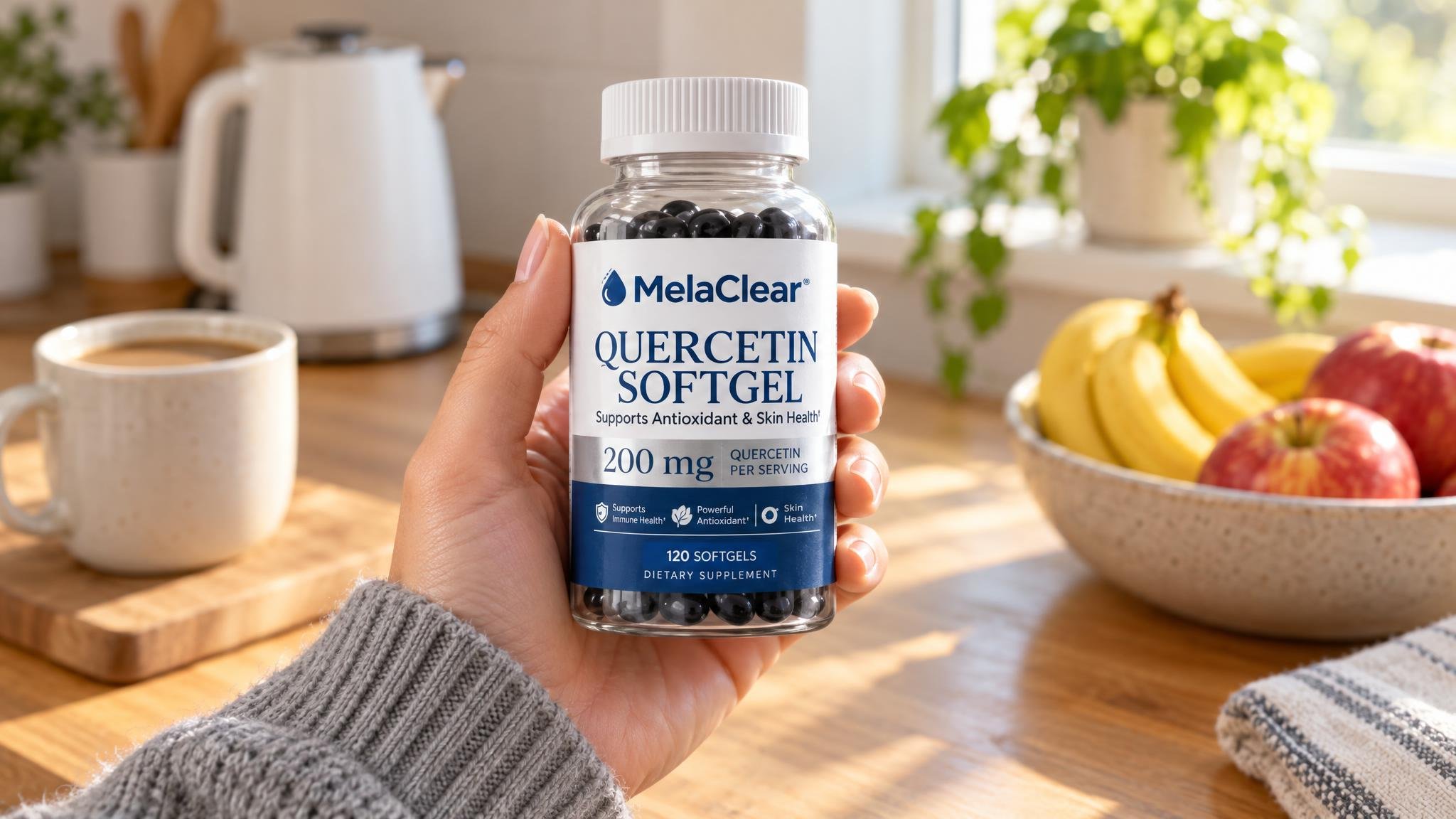
The cream I used to prescribe: 4% hydroquinone, topical application.
Clinical guidelines: 4 to 5 months maximum, then a mandatory forced break.
Level of action: The paint, never the paint sprayer.
The oral route that reaches the cell: 561 patients studied, nearly 9 in 10 saw improvement.
Level of action: Reaches the living cell directly through the bloodstream.
For years, I was prescribing the version that couldn't physically get there, with a ticking clock attached to it.
What Patients Who Switched Actually Reported
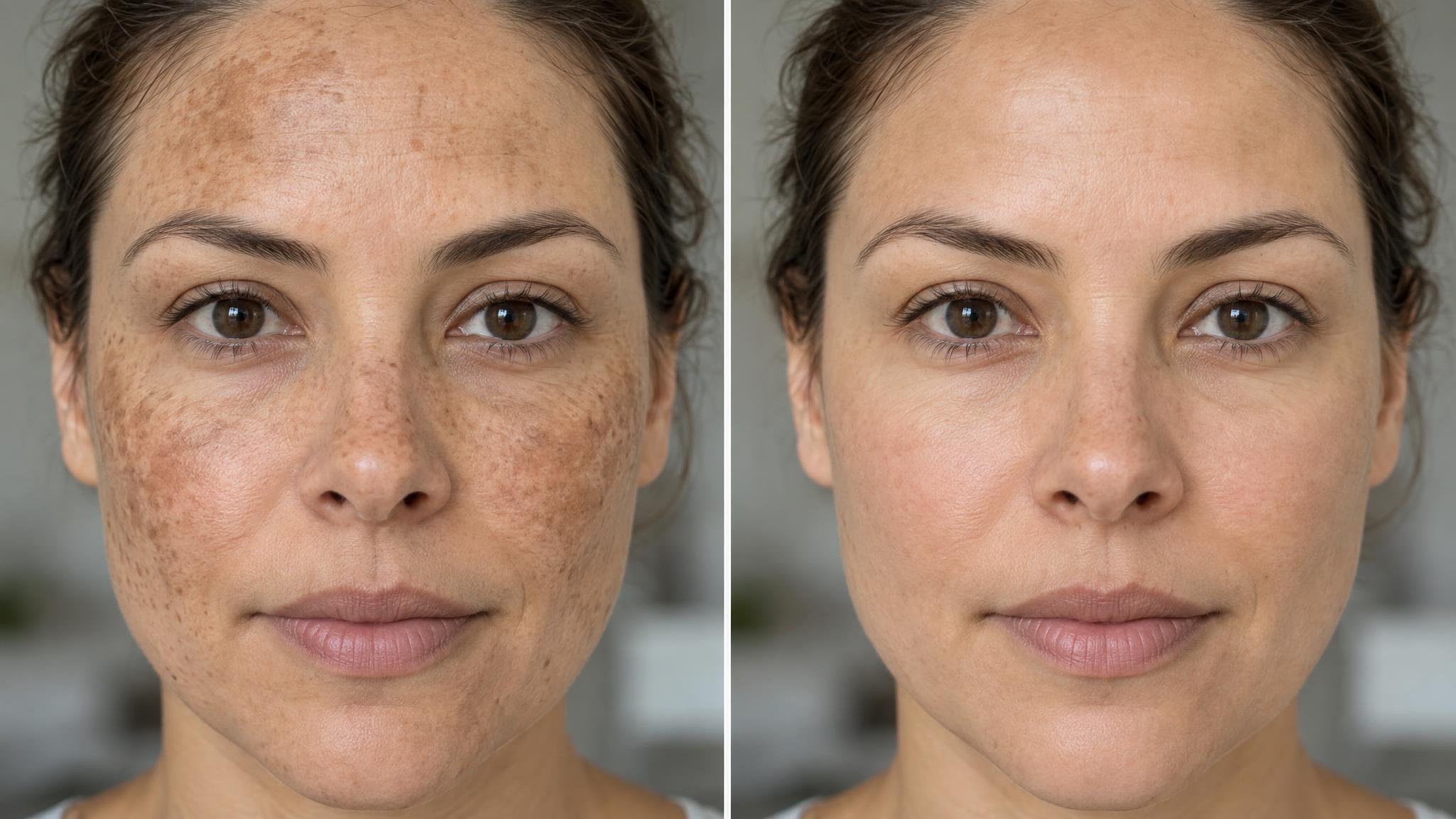
Week 1: No burning, no peeling, nothing to manage—just one softgel at breakfast, and skin already feeling calmer and less reactive around the patches.
Week 2: The first patients send me photos; the edges of the patches look softer in natural daylight.
Week 3: One patient went to the grocery store without concealer for the first time since having her children.
Week 4: This is where most patients start seeing it clearly in photos, the dark spots appearing less sharp against the rest of the skin.
Month 2: Seven patients told me they completely stopped applying foundation specifically on their cheekbones—the exact area they had been caking with makeup for years.
Month 3: A patient who first developed melasma years ago told me she finally stopped avoiding group photos at her son's birthday party.
Month 5: She sent me a photo from the beach—no hat, no foundation.
DR. REYES' CLINICAL PROTOCOL
"Because skin cells turn over on a 28-day cycle, clearing accumulated dermal pigment requires a minimum of 60 to 90 days. I advise all my patients to begin with the 3-month reset protocol."
👉 Start Your 90-Day Reset Protocol Today →Your Questions, Answered
Do I need to stop my current skincare routine?
No. Keep your daily sunscreen and your current gentle moisturizer. MelaClear works from the inside out to support your skin; it complements your routine rather than replacing it.
Is this safe for long-term daily use?
Yes. Unlike hydroquinone—whose clinical guidelines mandate an interruption after 4 or 5 months to prevent rebound and ochronosis—MelaClear is formulated with gentle, food-derived botanical compounds with no forced cycling limit.
How does this differ from prescription oral treatments?
It uses the exact same systemic principle—reaching the melanocyte via the capillary bloodstream—without the clotting risks, hair-thinning concerns, or physician monitoring associated with pharmaceutical tranexamic acid.
Who should consult a doctor before taking it?
MelaClear is formulated for adult women and men. However, because it contains Ashwagandha, it should not be taken by women who are pregnant or breastfeeding. If you have an underlying medical condition, consult your doctor.
The 90-Day Unconditional Guarantee
Every bottle comes backed by an unconditional 90-day, empty-bottle money-back guarantee.
Take MelaClear daily for 90 days. If the visible spots on your photos haven't softened and your skin tone isn't noticeably more even, simply send an email for an immediate, full refund.
No questions asked, no forms to fill out, and no fine print. Pigment cells run on a biological cycle, so you have a full 90 days to evaluate your results risk-free.
Two Paths From Here

You can keep doing what you’ve been doing.
Another cream, another eight-week cycle, another appointment where the dose gets adjusted and you go home. That is one road, and you already know where it leads, because you’ve walked it before.
Or there is a second option:
Reach the layer that has never been touched.
And show up to the next birthday photo without checking the lighting first.
Real Community Comments
Add a comment...
Can anyone verify this?
Like · Reply · · 1h
My melasma came back worse than ever after having my third child. My doctor just told me to wait it out. Dr. Reyes' article was the very first thing that actually explained WHY it kept returning instead of just telling me to be patient. Two months later, I can finally look at photos without wincing.
Like · Reply · · 55 min
I bought mine at full price last month and now there's a bundle discount? Not fair! But honestly, this formula is the only thing that worked on my cheek patches after two years of failed creams.
Like · Reply · · 49 min
Catching yourself off guard in an unposed photo... that hit me right in my chest. I've spent years deleting candid photos. I just got back from my nephew's wedding and for the first time in ten years, I kept every single picture. Every one.
Like · Reply · · 41 min
I need to try this so badly, just waiting for payday on Friday!
Like · Reply · · 39 min